
When a Museum Becomes a Place for Support, Not Just Display |
Museums are often thought of as places to observe - to walk through, look closely, and move on. Increasingly, though, some are becoming places to participate, linger, and return to for reasons that extend beyond art itself.
That shift is visible at the Coral Springs Museum of Art, where new art therapy sessions are now being offered specifically for veterans and teens.
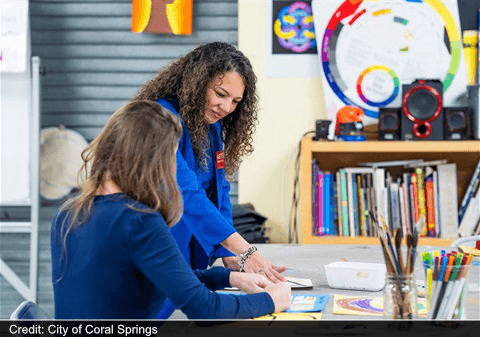
The program runs on select Fridays through early 2026 and is structured around small-group sessions guided by a licensed art therapist.
Growing: Museums As Therapy Centers
On the surface, the offering looks simple: scheduled time, shared space, creative materials. But its significance lies less in the format and more in what it suggests about how cultural institutions are redefining their role within the community.
Rather than positioning art solely as something to be viewed, programs like this treat creativity as a tool - a way to process experiences that may be difficult to articulate. Participants aren’t there to produce finished work or learn technique. The focus is on the act of making, reflecting, and connecting.
The sessions are facilitated by Alicia Ballestas, a board-certified art therapist whose work centers on helping individuals navigate stress, transition, and emotional complexity through creative practice.
Each session follows a consistent rhythm: a brief check-in, guided exercises that may include drawing or breathing techniques, and time for reflection that unfolds naturally rather than on cue.
Why Art Therapy?
What makes the program notable isn’t novelty. Art therapy has been used in various settings for decades. What stands out is where it’s happening — in a museum that many residents already associate with exhibitions, classes, and events.
That choice reflects a broader evolution in how public-facing spaces are used. As communities look for ways to support mental and emotional wellbeing without stigma or spectacle, familiar environments can offer an entry point that feels accessible rather than clinical.
For veterans and teens in particular, that setting may lower barriers to participation simply by feeling less formal.
The museum’s involvement also signals a shift in how cultural institutions measure value. Success isn’t defined only by attendance numbers or rotating displays, but by how the space supports people in their day-to-day lives. The art remains central, but its function expands.
Importantly, the program isn’t framed as a solution or a statement. It operates quietly, on a recurring schedule, and with limited group sizes. Veterans may attend at no cost, while teen sessions are offered for a nominal fee.
Registration details are available online, but the emphasis stays on continuity rather than promotion.
Over time, offerings like this subtly change how a place is perceived. A museum becomes not just somewhere to visit occasionally, but somewhere that serves a purpose — a place associated with routine, care, and return.
In Coral Springs, that kind of evolution mirrors a broader pattern. As the city grows and diversifies, institutions that adapt tend to do so by widening their definition of service rather than reinventing themselves entirely. The building stays the same. The role expands.
Sometimes, the most meaningful community shifts aren’t announced loudly. They happen when familiar places begin to meet people where they are.
----------
This story is part of The Bright Side, which is an ongoing series from Coral Springs Insider that highlights positive developments and community moments around Coral Springs.
Editor’s note: This piece was selected and adapted for Coral Springs Insider to provide local context and perspective on an issue relevant to our community. |
0 Comments
Join the conversation
Be the first to comment
Share your thoughts above.