
The Coral Springs Land Bought for Parking Became Homes |
Habitat for Humanity’s Riverside Drive townhomes took shape through a city land donation, financial support and a commitment from the buyers themselves. |
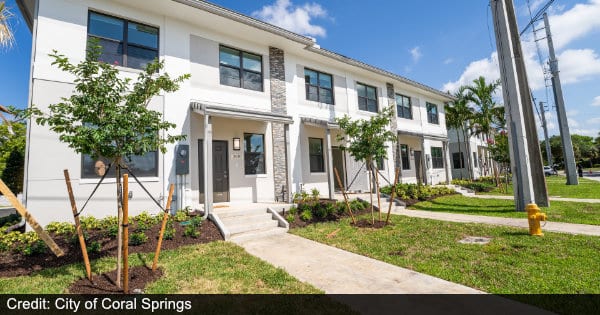
On Riverside Drive, just north of Sample Road, 13 townhomes stand on land Coral Springs once bought for a different purpose: neighborhood parking.
The homes were dedicated on May 22, 2025. They belong to a completed Habitat for Humanity of Broward development, with three- and four-bedroom homes for nearly 60 parents and children, according to Habitat’s project description.
Their history offers a specific answer to a familiar housing question: where can another opportunity for homeownership come from in an established neighborhood?
In this case, it began with land the city already owned.
A Parking Plan That Changed
City records trace the properties to 1995, when Coral Springs purchased six lots along Riverside Drive to address anticipated parking concerns associated with widening the road. The land remained vacant.
By 2006, the city had identified those lots as potential affordable-housing sites. Habitat was selected as developer in 2021, and the properties were declared surplus in 2022. Planning documents grouped the project into two sites, with seven homes on one and six on the other.
That distinction matters. These homes did not replace an operating neighborhood parking lot. They used vacant land originally acquired for parking.
The city’s planning records show the work involved in fitting homes onto those sites, including access, landscaping and parking arrangements. Changing the purpose of the land still required designing a development that could function beside existing neighbors.
Land Was Only Part of the Contribution
Coral Springs donated the property and contributed $375,000 toward development of the 13 townhomes, as documented in its 2025–2029 consolidated housing plan.
The city’s completed-project dashboard explains the purpose of that financial support: subsidizing development costs and offsetting buyers’ purchase prices.
The city contribution therefore worked on two parts of the same problem. It supplied a place to build and helped reduce the cost of producing the homes.
The $375,000 is a documented city grant, not the development’s total cost. Habitat also identifies private foundations, businesses and other home sponsors that supported the community.
A piece of land can remain physically unchanged for years while the possibilities for its use change around it. On Riverside Drive, the decision to revisit its purpose created room for a small homeownership development.
The Buyers Had Work to Do, Too
Habitat Broward’s homeownership model involves buyers who qualify based on housing need, willingness to participate and ability to pay. Its program includes 300 hours of sweat equity, homeowner education, a down payment and a mortgage.
Those work hours can extend beyond construction.
In April 2025, TAPinto reported on future homeowner Brenda Gonzalez, a mother of two preparing to move into the Riverside Drive development. After an unsuccessful initial application, she improved her finances and reapplied. Her sweat-equity work included financial classes, shifts at Habitat’s ReStore and work at the construction site.
Her experience gives the project a scale that a development count cannot: preparing to own a home involved learning, qualifying and contributing time before moving day.
What the Finished Homes Explain
Thirteen homes cannot resolve Coral Springs’ housing needs. They do provide a completed example of how public land, targeted financial support, private sponsorship and buyer participation can work together.
The result is concrete enough to examine without assuming every vacant parcel could support the same approach. A site still needs to accommodate housing, and a development still needs funding, approvals and buyers who can sustain ownership.
For residents interested in Habitat’s current opportunities, its homeownership program page is the place to check application information. This completed development should not be read as an announcement that its homes are currently available.
The Riverside Drive story is useful long after the dedication ceremony. It records how a city reconsidered land it had held for decades, and what became possible when that land was given a different job.
──────────
This story is part of The Bright Side, which is an ongoing series from Coral Springs Insider that highlights positive developments and community moments around Coral Springs.
Editor’s note: This piece was selected and adapted for Coral Springs Insider to provide local context and perspective on an issue relevant to our community. |
0 Comments
Join the conversation
Be the first to comment
Share your thoughts above.