
The Firefighting Tool Designed to Reach Places a Hose Can't |
Coral Springs-Parkland firefighters are introducing a system that can cut through certain barriers to deliver water closer to hidden fires. Its potential uses extend beyond electric vehicles. |
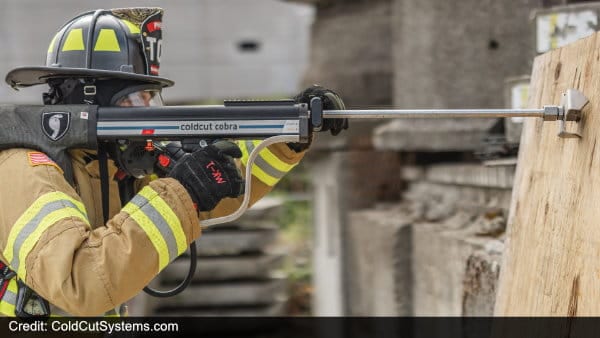
Sometimes the hardest part of fighting a fire isn't getting water to the scene. It's getting water to the place where the fire is actually burning.
A blaze can develop behind a wall, inside an attic or within an electric vehicle's battery pack. Even when firefighters know where the danger is, reaching it can be another challenge entirely.
That's the problem behind a new tool being introduced by the Coral Springs-Parkland Fire Department.
During an October 9 demonstration at the Coral Springs Regional Institute of Public Safety, firefighters showed how the Cold Cut Cobra system uses high-pressure water and an abrasive material to cut through metal.
But cutting through metal isn't the real point. It's what the equipment can do after creating an opening that makes it interesting.
Getting Water Where a Hose Can't Easily Reach
Conventional firefighting hoses are designed to deliver water where crews can direct it. But when flames or intense heat are concealed behind a physical barrier, firefighters may have difficulty reaching the burning material directly.
The Cold Cut Cobra approaches that problem differently.
The Swedish-developed system combines an abrasive material with a high-pressure water stream to penetrate certain surfaces. Once an opening is created, water can be directed into the enclosed space.
In a concealed structural fire, that can allow crews to begin cooling hot gases and suppressing fire without first opening up the entire area.
It's a different approach to a familiar firefighting challenge. Rather than immediately removing a barrier to reach the flames, the system is designed to work through the barrier itself.
That doesn't make it a replacement for conventional hoses or other firefighting techniques. Its effectiveness depends on the type of fire, the material involved and the conditions crews encounter.
But it offers another option when access is part of the problem.
Why Electric Vehicle Batteries Present a Different Challenge
Electric vehicle fires have become an important part of the conversation around the technology.
Most electric vehicles do not experience battery fires. But when a lithium-ion battery does undergo a serious failure, the resulting emergency can be difficult to manage.
One concern is thermal runaway, a process in which heat generated by a failing battery cell can spread to neighboring cells.
The affected cells may be enclosed within a protective battery pack, making it difficult for water applied from outside the vehicle to reach the hottest areas.
The Cold Cut Cobra offers a potential way to address that problem.
By penetrating an appropriate part of the enclosure, trained firefighters may be able to introduce water closer to the affected battery modules.
That approach has been examined in controlled experiments. Research discussed by the Swedish Civil Contingencies Agency and international firefighting organizations found that internal water application could stop thermal propagation in tested battery configurations.
Those findings are promising, but they don't mean every battery pack can be safely penetrated or every fire will be extinguished without reignition.
Vehicle design, battery condition and the circumstances of the emergency still matter.
The equipment is best understood as a specialized option within a broader firefighting response, not a guaranteed solution to every electric vehicle fire.
It's Not Just About Electric Cars
Although battery-powered vehicles were a focus of the local demonstration, the technology has potential uses beyond cars.
Division Chief Chris Bator identified attic fires and incidents involving electric scooters and e-bikes among the situations where the equipment could be useful.
Those examples share an important characteristic: the source of the fire may be difficult to reach.
An attic fire can develop behind ceilings or other structural materials. Battery-powered scooters and bicycles can present their own challenges when lithium-ion cells are involved.
The Cold Cut Cobra was developed for concealed-fire applications, and its possible use in battery emergencies builds on that original purpose.
For firefighters, the value isn't simply having a tool that can penetrate metal. It's having another way to approach situations where the burning material is separated from crews by a barrier.
What Coral Springs-Parkland Has Introduced
The Coral Springs-Parkland Fire Department acquired the Cold Cut Cobra system through Urban Area Security Initiative grant funding.
According to Bator, the equipment is mounted on one department vehicle, and he hopes it can eventually be installed on additional vehicles.
The manufacturer scheduled an instructor-training course in Coral Springs for October 7 and 8, followed by the October 9 demonstration.
At Parkland's October 7 City Commission meeting, the department was described as working to implement the system as part of its preparations for lithium-ion battery emergencies.
Those developments show that the department is investing in a new capability.
They don't establish how many firefighters have completed training, whether the system is routinely deployed or whether it has already been used during a local emergency.
That distinction is important. A public demonstration shows what the equipment is designed to do. Its eventual role in everyday emergency response will depend on training, procedures and operational experience.
A Different Way to Think About Firefighting
The Cold Cut Cobra's most interesting feature may be the problem it asks firefighters to reconsider.
When a fire is hidden behind a barrier, the challenge isn't always a shortage of water. Sometimes it's the difficulty of getting that water to the right place.
For Coral Springs and Parkland residents, the October demonstration offered a glimpse of how the fire department is preparing for emergencies involving concealed spaces and modern battery-powered equipment.
The new system won't eliminate those hazards or replace established firefighting methods.
But when reaching the source of a fire is part of the danger, having another way to get water there could give firefighters a valuable additional option.
----------
This story is part of The Bright Side, which is an ongoing series from Coral Springs Insider that highlights positive developments and community moments around Coral Springs.
Editor's note: This piece was selected and adapted for Coral Springs Insider to provide local context and perspective on an issue relevant to our community. |
0 Comments
Join the conversation
Be the first to comment
Share your thoughts above.