
Why Coral Springs Students Are Bringing More of School Home |
For generations, the basic geography of school was pretty easy to understand.
Students went to a building. Teachers taught there. Most of the equipment provided by the school stayed there.
Students might carry textbooks, worksheets and homework between school and home, but the infrastructure supporting education largely remained inside classrooms, libraries and computer labs.
That distinction is becoming harder to make.
Broward County Public Schools' One-to-One Laptop Program allows eligible K–12 students to take district-issued computers home for the 2026–27 school year.
Families have to opt into the program. The laptops still belong to the school district. Yet where those computers belong physically is becoming much less obvious.
When School Equipment Leaves School
BCPS describes the purpose of its One-to-One Laptop Program simply: giving students access to digital learning resources **wherever learning takes place**.
That phrase captures something larger than the laptop program itself.
A district-issued computer is no longer necessarily equipment a student uses during computer class or visits a school library to access.
It can travel home at the end of the day and return to school the next morning. That allows the same device to support learning in both places.
For families in Coral Springs and throughout Broward County, participating requires a parent or guardian to opt in through the district's Focus Parent Portal.
Once participation is confirmed, the student receives a take-home device.
For elementary and middle school students, BCPS lists an HP Fortis Flip with 8 GB of memory. High school students receive an HP EliteBook 6 with 16 GB.
Those specifications aren't particularly important by themselves. What matters is what the district expects the devices to do.
They aren't merely computers located at school. They're becoming portable access points to school itself.
Access Without Ownership
There's another interesting distinction in the program.
Students can take the laptops home. But the laptops don't become theirs.
The School Board of Broward County retains ownership, and families accept responsibility for the devices while they're checked out.
The district requires laptops to be returned in good condition when requested and before students transfer to another public, private or out-of-county school.
Families must report damage to the issuing school, and repairs are handled exclusively through the district.
Loss or irreparable damage can result in families being required to reimburse BCPS for the computer's original purchase price.
The district lists the elementary and middle school laptop at $318.48 and the high school model at $522.48, in addition to replacement costs for protective cases or missing power adapters.
That arrangement creates an unusual middle ground. The computer is public-school equipment. But for potentially much of the school year, a family is responsible for caring for it at home.
The Boundary Doesn't End at the Front Door
The connection between school and home extends beyond possession of the computer.
BCPS says content filtering remains active on district devices at all times.
Parents, meanwhile, are responsible for monitoring student use at home, particularly internet activity when the device is away from the school network.
So several things cross the school boundary together.
The hardware goes home. Digital learning resources go with it. District technology protections continue operating.
And some responsibility for supervising how that school-owned technology is used shifts to parents.
That's a considerably different relationship between the classroom and household than simply sending home a worksheet.
Why Providing the Device Matters
For many families, none of this may seem remarkable. Computers, tablets and internet-connected devices have become ordinary parts of household life.
But access isn't identical from one household to another.
One student may have a relatively new computer available whenever it's needed.
Another may share a computer with siblings or parents. Another household may rely primarily on phones or older equipment.
BCPS explicitly identifies equity as one reason families may want to opt into its laptop program.
Providing the device doesn't erase every difference between households.
It does address one particularly important one:
That's increasingly consequential because the tools used during the school day don't necessarily stop being useful when students leave campus.
School Is Becoming Less About a Place
None of this means the physical school is becoming unimportant. Students still need classrooms.
Teachers. Libraries. Laboratories. Athletic facilities. Arts spaces. Counselors. Classmates.
The physical experience of attending school remains central to education.
What's changing is the assumption that everything required to participate in school remains inside that building.
A district-owned laptop can travel between two worlds. At 10 a.m., it's school equipment sitting on a student's desk.
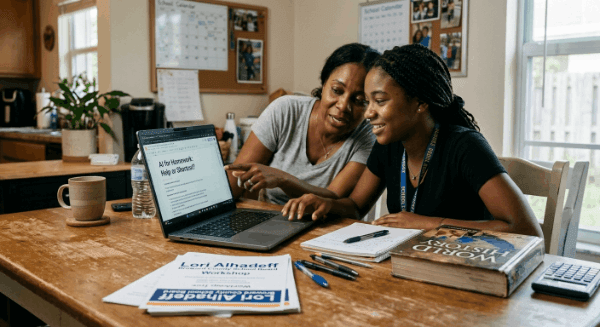
Several hours later, that same piece of school equipment may be sitting on a kitchen table in Coral Springs.
The location changed. Its purpose didn't.
That may be the most interesting thing about Broward's take-home laptop program.
The district isn't simply providing students with computers. It's acknowledging something families increasingly experience for themselves.
The school day may still begin and end at a school building. The tools needed to participate in it increasingly don't. Learn more here.
----------
Editor’s note: This piece was selected and adapted for Coral Springs Insider to provide local context and perspective on an issue relevant to our community.
|
0 Comments
Join the conversation
Be the first to comment
Share your thoughts above.