
What Happens After Coral Springs Asks Residents What They Want |
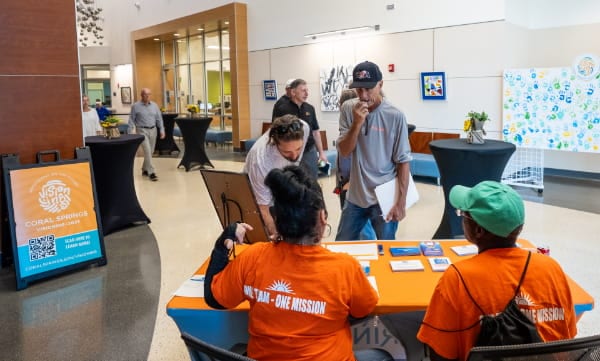
More than 2,000 people answered a question about what they hoped Coral Springs would become by 2035. Their priorities are now showing up in the planning and budget process that can eventually turn broad ideas into visible changes.
Filling out a city survey takes a few minutes. Seeing what happens afterward can take years.
That difference helps explain why public participation can sometimes feel temporary.
A resident answers a question, attends a meeting or shares an opinion. Then the survey closes. The meeting ends.
And whatever happens next largely disappears inside government. Coral Springs' Vision 2035 process offers a chance to follow some of that journey.
Because the question residents were asked was unusually large: What do you hope to see in your community in the next ten years?
Thousands of Answers to One Big Question
Coral Springs began its Vision 2035 process in October 2022. The city didn't rely solely on an online survey.
It promoted the effort through city events, boards and committees, schools, parks, businesses, churches, HOAs, recreational facilities and other community organizations.
By the time the process reached a community summit in January 2024, the city says it had created more than 108,000 opportunities for interaction and collected 2,379 Visioning Survey responses. Those answers weren't identical.
Some residents wanted greater walkability. Some raised concerns about housing affordability and taxes. Others talked about parks, transportation, schools, businesses, community appearance and events.
City staff analyzed the responses and organized them into seven broad themes.
Then residents, business owners, elected officials and city staff gathered at a Visioning Summit to further discuss and prioritize them.
At that point, however, Coral Springs still hadn't built anything. That's where the less visible part of public participation began.
A Priority Isn't a Project
A resident can say: **We want a more walkable Coral Springs.**
But a city can't put “walkability” on a construction schedule. Someone has to decide what that means.
A sidewalk? A shared-use path? Better connections between destinations? ADA improvements? Then come the other questions. Where? When? How much? Which department? What gets funded first?
That's the distance between expressing a community preference and turning one into something government can actually implement. Vision 2035 was designed to help bridge that distance.
Coral Springs says that beginning with its Fiscal Year 2025 budget process, Vision 2035 themes and community input were incorporated into annual budgets through targeted initiatives.
In other words, the survey wasn't intended to produce 2,379 individual promises.
It helped establish directions. Those directions then had to enter the machinery of planning and budgeting.
What That Can Look Like on the Ground
Consider walkability. The Vision 2035 results identified a desire for a more walkable community. The city's subsequent strategic plans included a Sidewalk Replacement and ADA Streets Plan.
Improvements have since been completed along Westview Drive, while work continues along Coral Hills Drive to provide concrete shared-use paths for pedestrians and bicyclists.
Does that mean someone wrote “fix this sidewalk” on a Vision 2035 survey and the city built it?
Not necessarily.
Projects can have histories and reasons that extend beyond a single public-engagement process.
The connection is broader.
Walkability emerged as a community priority, became part of the city's Vision framework and is now reflected in initiatives the city tracks within that framework.
That's a more realistic picture of how public input can influence a city.
The Same Pattern Appears Elsewhere
Housing provides another example. Residents raised affordability during Vision 2035.
The city's strategic plan now places housing initiatives beneath that Vision theme, including its partnership with Habitat for Humanity on 13 affordable townhomes built on city-owned property.
The city invested $375,000 from its Affordable Housing Trust Fund alongside other housing funds to help support the project.
Final certificates of occupancy were issued in May 2025. Again, it would be too simple to say a survey created those homes. It didn't.
But housing affordability was one of the concerns residents identified, and the city now places the project within the strategic framework shaped partly by those community priorities.
That distinction matters.
Public input doesn't necessarily create a project. It can help influence which problems remain visible when priorities and resources are being discussed.
Even the Way Coral Springs Looks Can Trace Back to a Priority
One of the seven Vision themes was City Aesthetics.
That may sound abstract. Eventually, abstract priorities have to become specific.
Since 2025, Coral Springs has created an internal Aesthetics Team, added two Community Aesthetics Inspectors, pressure-washed 34 miles of sidewalk along major corridors, developed a Master Sign Plan and identified more than 100 opportunities for operational or aesthetic improvements at major intersections.
The city also describes its Street Tree Program as a key Visioning initiative.
That program includes residential street-tree enhancements and efforts to replace some palms with more sustainable, shade-producing trees.
A phrase such as “maintain the appearance of Coral Springs” can sound vague when residents express it.
Years later, it may appear as a tree, a sign, a landscaped median or a cleaner corridor.
That's why the connection can be difficult to see.
Two Different Clocks
There are really two clocks operating in a process like Vision 2035. The first belongs to the resident.
Answering a survey might take five minutes. Attending a meeting might take an evening. Then life moves on.
The second belongs to city government.
Community input has to be analyzed. Priorities have to be established. Projects have to be developed. Funding has to be identified. Budgets have to be approved.
Design and procurement may follow. Construction or implementation can come later still.
By the time something changes, the resident who participated may no longer remember the survey.
That doesn't prove every piece of public input changed the outcome. And it doesn't mean everyone who participated will agree with what the city ultimately chose to do.
But it helps explain why the effect of civic participation can be difficult to recognize even when public input remains part of the planning process.
Not Everything Residents Asked For Happens
That's another important part of understanding Vision 2035. A community survey isn't a referendum.
The most popular suggestion doesn't automatically become city policy.
Some priorities compete with others. Some cost more than a city can afford. Some fall outside municipal authority. Others may take years before an opportunity appears.
And broad community preferences still have to pass through elected officials, budgets, regulations, professional planning and changing circumstances.
Vision 2035 itself is designed to remain flexible rather than operate as a fixed list of promises.
That's important because Coral Springs in 2030 won't face exactly the same circumstances it faced when residents answered surveys in 2023.
The Vision establishes direction. The route can change.
When an Answer Becomes Hard to Recognize
That's perhaps the most interesting thing about following Vision 2035 from survey responses into strategic plans.
Residents may imagine the effect of public input as something immediate.
Ask. Answer. Act. City-building rarely works that way.
A resident may ask for a more walkable community without ever knowing which sidewalk project eventually became part of that goal.
Someone may say Coral Springs should remain green without knowing that years later the city would describe a street-tree program as a Visioning initiative.
Someone concerned about affordable housing may never connect that response with a city budget document discussing housing initiatives.
The original opinion becomes harder to recognize as it moves deeper into the process. But that doesn't necessarily mean it disappeared.
Giving your opinion about the future of a city can take a few minutes.
Finding out what becomes of it may take years.
If you could name one thing you'd like Coral Springs to look or feel different by 2035, what would it be?
Tell us below.
----------
Editor’s note: This piece was selected and adapted for Coral Springs Insider to provide local context and perspective on an issue relevant to our community. |
0 Comments
Join the conversation
Be the first to comment
Share your thoughts above.