
Why E-Bikes Are Changing How Kids Get Around Coral Springs |
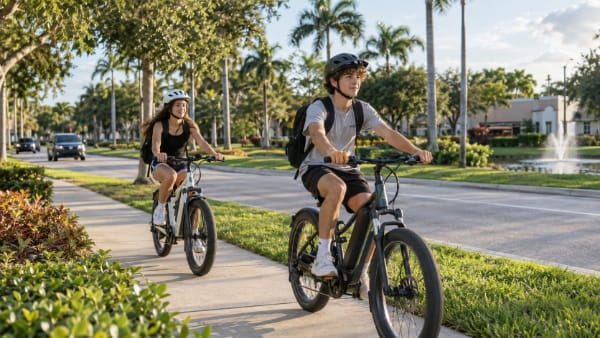
Electric devices are giving young riders another way to move independently through Coral Springs. The city's rules—and a growing number of crashes—show what happens when that independence arrives with more speed.
For generations, getting a bicycle has meant more than getting a bicycle. It could mean getting to a friend's house without asking for a ride.
Getting to a park. Exploring a neighborhood beyond your own block.
For many young people, a bike provided an early taste of something adults eventually take for granted: the ability to decide where to go and get there on your own.
Electric bikes haven't eliminated that kind of independence. They've expanded what it can look like. And Coral Springs is beginning to see what happens when a familiar form of youth transportation becomes faster.
When a Bicycle Doesn't Move Like the One You Remember
A legal electric bicycle in Florida can provide motor assistance at speeds up to 28 mph.
That doesn't make every e-bike fast, and it doesn't mean every young rider travels at that speed. But it changes what's possible.
Distance requires less physical effort. A longer trip can become more practical. And speeds that once required a strong cyclist can become available with electric assistance.
Yet legally, an e-bike still has much in common with the bicycle many adults remember riding as children.
Florida generally gives e-bike riders the same rights and responsibilities as bicycle riders. No driver's license is required.
Neither are vehicle registration or automobile-style insurance. And unlike driving a car, Florida currently has no statewide minimum age for operating a qualifying e-bike.
That creates an unusual space between two familiar forms of transportation. It's still a bicycle.
But it can provide a different level of mobility.
Coral Springs Was Already Seeing the Change
The city didn't begin reconsidering its e-bike rules because of crash statistics alone.
When Coral Springs changed its ordinance in 2025 to allow e-bikes and motorized scooters on most city sidewalks, commissioners cited increasing use of the devices, particularly among students.
The city was responding to something residents could increasingly see for themselves.
Young riders were already using electric devices to get around. Simply prohibiting them from sidewalks wasn't making that use disappear.
So Coral Springs tried to establish rules around it.
E-bikes and motorized scooters are now permitted on most sidewalks and bike paths at speeds up to 15 mph. Within 25 feet of a pedestrian, riders must slow to 5 mph or less.
They're prohibited on sidewalks and paths inside city parks.
The rules attempt to make room for a form of transportation that had already arrived.
Then the Crash Numbers Grew
Accommodating a new form of mobility doesn't automatically make it safe.
Coral Springs Police and the Coral Springs-Parkland Fire Department have responded to 86 crashes involving e-bikes, e-scooters and other electric devices since January, according to fire officials.
Sixty involved riders between 12 and 17.
In 66 of the crashes, the rider wasn't wearing a helmet, although officials did not specify how many of those riders were juveniles. Those numbers have prompted education and enforcement efforts from police and fire officials.
But they also illustrate something larger.
A young person can gain access to electric transportation without going through the structured transition society created around driving a car.
There is no learner's permit for a qualifying e-bike. No road test. No required driver's education course.
Yet the rider still has to understand intersections, traffic signals, pedestrians, visibility, right-of-way and how drivers behave.
The independence can arrive before the formal training does.
Not Everything That Looks Like an E-Bike Is One
The transition is complicated further by another problem: some electric devices that resemble e-bikes aren't legally e-bikes at all.
Coral Springs defines a qualifying e-bike as having operable pedals, a motor of 750 watts or less and a maximum assisted speed of 28 mph.
Go beyond those specifications and the legal category can change. The city describes faster electric two-wheelers as e-motos, which are treated much more like motorcycles.
Those devices cannot be operated on sidewalks. Operators must be at least 16, possess the required driver's license and motorcycle endorsement, and the vehicle must be registered with a valid license plate.
To someone watching from a passing car, the distinction may not always be obvious. Legally, it matters considerably.
One device belongs largely within the rules governing bicycles. Another belongs within the rules governing motor vehicles.
That makes understanding what a young rider is actually riding part of the challenge.
The Rules Are Still Evolving
Coral Springs isn't alone in trying to figure out where these devices fit. Florida changed state law in 2025 to give local governments additional authority over e-bikes.
Cities and counties may establish minimum ages for e-bike operation. They may require riders to carry government-issued photo identification.
They may also provide safety training.
Similar local authority applies to motorized scooters and other micromobility devices.
Florida hasn't imposed those additional restrictions statewide. Instead, it has given communities more ability to decide whether their local conditions require them.
That's another indication of how quickly this transportation category has developed. The technology arrived first.
Some of the rules are following afterward.
A Different Kind of First Independence
None of this makes the old bicycle comparison perfect. Children have always been capable of riding bicycles unsafely.
They've always crossed streets, ignored helmets and made mistakes in traffic. And e-bikes can provide real benefits.
They can make longer trips easier. They can give families another transportation option. They can allow some trips to happen without a car.
That is part of why Coral Springs commissioners cited their transportation potential when changing the city's rules.
The difference is what electric assistance adds to the equation.
A bicycle once expanded the boundaries of a child's neighborhood largely through the rider's own effort. An electric motor can expand those boundaries differently.
The rider may still be young. The bicycle may still have pedals. But the distance and speed available to that rider can look less like the bicycle independence previous generations remember.
When Transportation Changes Faster Than Habits
That's why Coral Springs' 86 crashes shouldn't be read only as a warning about a dangerous product.
They're also evidence of a community adjusting to a transportation change already underway.
Parents are learning that not every electric two-wheeler is legally the same. Young riders are learning rules that matter once a bicycle begins moving more like a vehicle.
Drivers are sharing streets and intersections with a growing category of road users. And local government is deciding where those devices should operate and how fast they should move around pedestrians.
The bicycle hasn't stopped being a symbol of childhood independence. But electricity has changed what that independence can do.
For earlier generations, learning to ride was often the beginning of getting around on your own.
For today's young riders, communities are discovering that learning where—and how—to ride may matter just as much.
How did you get around independently when you were young—and what feels different about the way kids get around today?
Tell us below.
----------
Editor’s note: This piece was selected and adapted for Coral Springs Insider to provide local context and perspective on an issue relevant to our community. |
0 Comments
Join the conversation
Be the first to comment
Share your thoughts above.