
Why Coral Springs Wants a Hotel at the Sportsplex |
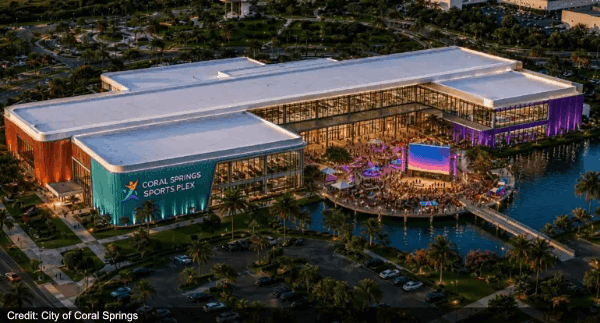
The city's search for a private developer to build at least 225 rooms beside its sports facilities reveals another part of the strategy for turning tournaments and competitions into overnight visits.
A hotel might not be the first thing that comes to mind when thinking about the future of the Coral Springs Sportsplex.
Basketball courts, swimming pools and athletic facilities make sense. But now the city is looking for someone to build hotel rooms there, too.
Coral Springs has begun seeking proposals from private developers to design, finance, construct and operate a hotel on 4.5 undeveloped acres at the southeast corner of Sportsplex Drive and Sample Road.
The requirements call for at least 225 rooms, a minimum three-star or diamond rating, pool features and a rooftop bar or lounge.
No developer has been selected, and seeking proposals doesn't mean the hotel will ultimately be built.
But the location of the proposed hotel helps explain something larger about what Coral Springs is trying to create at the Sportsplex.
What Happens When the Visitors Don't Go Home?
For years, much of the Sportsplex has functioned the way residents expect a large municipal recreation area to function.
People arrive. They swim, play tennis, attend practices, compete, exercise or watch games. Then many go home.
The city's larger Sportsplex strategy introduces another kind of user. A visiting team arriving for a regional tournament may stay for a weekend.
A swimmer traveling for a multi-day competition may need a room. Parents, coaches and spectators traveling with them need places to eat and things to do between events.
That changes the economics of a sports facility. The competition may take place inside the Sportsplex. Much of the spending it produces can happen outside it.
From Recreation Complex to Destination
Coral Springs has explicitly identified creating a “Destination Attraction” at the Sportsplex as part of its strategic planning.
The city is pursuing a major redevelopment of the area that could expand its ability to host sports, community events and competitions.
That matters because larger facilities can accommodate events the existing complex cannot.
Coral Springs officials have previously pointed to tournaments that must spread games among multiple locations because the Sportsplex doesn't have enough capacity.
The goal isn't simply to give existing users more room. Part of the strategy is to make Coral Springs capable of attracting larger events and more visitors.
And visitors need more than courts and pools.
The Hotel Demand Isn't Entirely Hypothetical
Athletes and competitors already travel to Coral Springs. The city's Aquatic Complex maintains a list of hotels for visiting athletes and event participants.
Some are in Coral Springs. Others are in Coconut Creek, Tamarac, Plantation, Fort Lauderdale and Pompano Beach.
That means the relationship between sports and lodging already exists.
The new hotel solicitation raises a different question: What happens if more of that lodging can occur beside the place people came to use?
A hotel at the Sportsplex could potentially make the trip easier for visiting athletes and families while keeping more of their overnight activity within Coral Springs.
But its significance goes beyond the room itself.
Why Overnight Visitors Matter
Consider two families attending the same tournament. One lives nearby, drives to Coral Springs in the morning, watches the games and drives home that evening.
The other travels from several hours away and stays for two nights. Both attended the tournament.
Economically, their visits can look very different. The second family may pay for a hotel room. They may eat several meals locally. They may buy groceries, fill a gas tank or visit nearby stores. They may have hours between games to spend elsewhere in the city.
That is why sports-tourism studies pay so much attention to overnight visitors.
A consultant's analysis of the proposed Sportsplex expansion projected approximately $20.7 million in visitor-related economic activity during its first year, including spending associated with hotels, restaurants and other businesses.
Those are projections, not guarantees. Actual tournaments, attendance and spending could turn out differently.
But they reveal an important assumption behind the strategy: The economic value of a destination doesn't stop at its front door.
A Pattern Coral Springs Can Already See
Coral Springs doesn't have to imagine the relationship entirely from scratch. Existing sporting events already generate hotel stays.
In documents submitted to the city, organizers of a long-running basketball tournament described participants staying in Coral Springs hotels and spending money at restaurants and businesses during the event.
The Sportsplex expansion attempts to create the capacity for more events capable of producing that kind of activity. The proposed hotel begins addressing what happens after those visitors arrive.
Those questions are easy to overlook when attention is focused on the size and cost of the sports facilities themselves.
The City Isn't Proposing to Run a Hotel
There's another important distinction. Coral Springs isn't proposing to build and operate a municipal hotel.
The city is seeking a private development partner to design, finance, construct and operate the property. That means the solicitation is also a test.
A public plan can identify a hotel as desirable. A private developer still has to decide whether the opportunity makes economic sense. Proposals are due October 21.
Until the city receives and evaluates them, there is no selected hotel operator and no guarantee that a hotel will rise on the property. That uncertainty matters.
A destination strategy ultimately depends on more than government planning. It also depends on whether visitors come in the numbers projected and whether private businesses see enough demand to serve them.
Building What's Around the Attraction
The biggest Sportsplex discussions have understandably focused on the facilities themselves.
Those are the visible parts of creating a destination. But successful destinations depend on less obvious infrastructure around them.
People need somewhere to stay. They need somewhere to eat. They need transportation. They need things to do when the event isn't happening.
And businesses need enough demand to make serving those visitors worthwhile.
The city's hotel solicitation makes one piece of that surrounding system visible.
When a Sports Complex Becomes More Than the Venue
A larger Sportsplex could attract competitions Coral Springs currently cannot accommodate. But attracting an event and capturing more of its local impact are different things.
The courts and pools give people a reason to come. A hotel gives some of them a reason to remain nearby after the competition ends.
Restaurants, stores and other businesses can become part of the visit without ever hosting a game themselves.
That's why the proposed hotel is worth noticing even before anyone knows whether it will be built.
It shows that Coral Springs is beginning to think not only about what happens inside a destination, but about what has to exist around one.
Building something people will travel to is one challenge. Creating a place where they can stay is another.
If Coral Springs attracts more weekend tournaments and visiting families, what else besides a hotel do you think visitors would need nearby?
Tell us below.
----------
Editor’s note: This piece was selected and adapted for Coral Springs Insider to provide local context and perspective on an issue relevant to our community.
|
2 Comments
Join the conversation
The city needs to look out for its citizens rather than visitors. The Sports Complex will not services residents..it will only bring more chaos, traffic and crime to an already
Thanks for sharing your perspective. You raise an important question about the proposal: whether the benefits of attracting more visitors to the Sportsplex would also benefit residents enough to outweigh concerns such as additional traffic and activity in the area. It will be worth watching as the project moves forward.