
What Makes Walking and Biking Realistic Options in Coral Springs? |
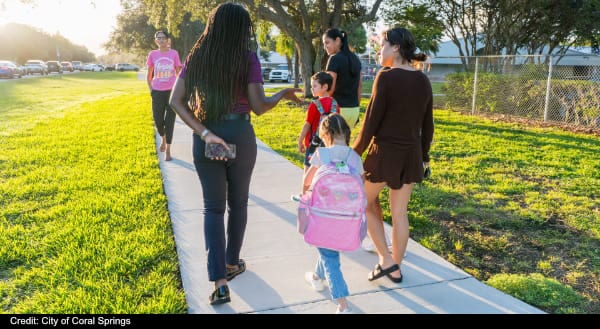
A sidewalk can connect two places. A bike lane can run for miles alongside a road.
But neither necessarily answers the question that may matter most to someone deciding whether to use it:
Would I actually feel comfortable traveling there?
That distinction is at the center of a Broward County transportation-planning effort that looks beyond whether walking and biking facilities exist. The county's Multimodal Mobility Master Plan is developing what it calls a “low-stress” network intended for people of different ages and abilities.
The idea introduces a different way of thinking about transportation choices in suburban communities like Coral Springs.
A route can exist on a map without feeling like a realistic way to get somewhere.
Measuring Something a Map Doesn't Show
Transportation planners have traditionally been able to identify sidewalks, bike lanes, intersections and other infrastructure. Broward's planning process adds another measure: Level of Traffic Stress.
The approach estimates the amount of stress someone may experience while walking or biking along a particular type of facility.
Lower levels represent routes more people are likely to feel comfortable using. Higher levels generally involve conditions such as faster or heavier traffic or facilities that are more difficult to navigate.
For bicyclists, Broward's planning materials describe Level 1 as comfortable enough for most children and Level 2 as tolerable for most adults. Levels 3 and 4 progressively require riders who are more confident or willing to tolerate stressful conditions.
The pedestrian scale similarly considers whether facilities can comfortably serve people including teenagers traveling independently, older adults and people using wheeled mobility devices.
That changes the meaning of a simple question like, “Is there a bike route?”
The answer can technically be yes while the practical answer for many residents remains no.
Broward Found a Difference Between Walking and Biking
When planners evaluated Broward's existing network, they found an important distinction.
Most county facilities assessed for pedestrians fell into the two lower traffic-stress categories. But most facilities evaluated for bicyclists fell into Levels 3 or 4 — conditions considered uncomfortable for most riders.
The county also looked at whether routes provide access to destinations people actually use, including schools, parks, jobs, grocery stores and transit.
Combining those two ideas — accessibility and comfort — creates a more useful question.
A route that feels comfortable but goes nowhere useful doesn't provide much transportation value. A route connecting important destinations may not provide much practical choice if most people are uncomfortable using it.
The goal is to create more places where both conditions exist.
From a Network to Possible Projects
In February, the Broward Metropolitan Planning Organization endorsed the proposed Low Stress Multimodal Mobility Network.
County planners told the MPO that the network identified approximately 250 potential projects, ranging from new side paths to widened sidewalks and upgrades of already planned facilities.
Those projects were categorized by how difficult they might be to implement based on factors such as available right-of-way, utilities and coordination among different government agencies.
That endorsement does not mean 250 projects have been approved, funded or scheduled for construction.
Individual projects still require additional feasibility work, prioritization, funding, design and, ultimately, decisions by the agencies responsible for them.
But the network provides something that comes earlier: a framework for identifying where another kind of transportation connection might be useful and what would be necessary to make it more comfortable.
Coral Springs Is Already Seeing Pieces of the Idea
The countywide plan isn't responsible for every walking or biking improvement occurring in Coral Springs. Several local and state projects developed separately. But they illustrate what changes in transportation infrastructure can look like locally.
The recently completed University Drive Mobility Improvement Project widened bike lanes from four feet to seven feet between Northwest 40th Street and the Sawgrass Expressway.
It also included pedestrian-signal upgrades, relocated sidewalks and other improvements along the corridor.
Coral Springs is also pursuing the Everglades Memorial Loop, a proposed 10.2-mile shared-use path intended to improve pedestrian and bicycle connections among residential areas, parks, recreational facilities and schools along the city's western edge.
The city's Comprehensive Plan also calls for considering multiple modes of transportation and improving pedestrian connections while coordinating with Broward County and other transportation agencies.
None of that means Coral Springs is becoming a city where residents no longer need cars.
The city's suburban geography and major road network make automobiles central to everyday transportation.
What is changing is the range of questions being asked about the alternatives.
The Difference Between Available and Usable
That distinction becomes more noticeable as the ways people travel continue to change.
A teenager on an e-bike, an adult walking to a nearby destination, someone reaching a bus stop, an older resident taking a longer walk, or a recreational cyclist may all encounter the same infrastructure differently.
Simply providing a route doesn't guarantee that each person will consider it practical.
That's why the language of “low stress” matters.
It moves the conversation beyond whether infrastructure exists and toward the experience of the person actually using it.
Transportation choice doesn't begin simply because another route appears on a map.
It begins when that route connects somewhere useful — and feels comfortable enough that ordinary people are willing to take it.
Is there somewhere in Coral Springs you would walk or bike to more often if the route felt easier or more comfortable?
Tell us where — and what gets in the way now.
Editor’s note: This piece was selected and adapted for Coral Springs Insider to provide local context and perspective on an issue relevant to our community. |
0 Comments
Join the conversation
Be the first to comment
Share your thoughts above.