
What Does 9/11 Mean to a Generation That Doesn't Remember It? |
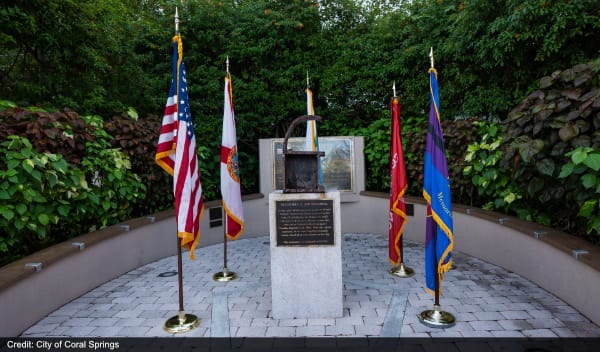
Twenty-five years after the attacks, the World Trade Center steel outside a Coral Springs library is beginning to serve people who know September 11 through history rather than memory.
Outside Northwest Regional Library sits a piece of steel from the World Trade Center.
For most of the year, everyday life happens around it.
People visit the library. Cars move along University Drive. Children arrive for programs. Residents walk past. Then September 11 comes around.
Flags appear. A wreath is placed. First responders gather. Radios go silent at the time the first plane struck the North Tower.
For years, the purpose of a memorial like this seemed straightforward.
Remember.
Twenty-five years later, something about that purpose is beginning to change. The steel hasn't changed. The people standing in front of it have.
Remembering Something You Experienced
Ask many Coral Springs residents where they were on September 11, 2001, and they can probably tell you.
They remember television images. They remember phone calls. They remember where they were working or who they were with. For them, a piece of World Trade Center steel connects with a memory that already exists.
Today's children have a fundamentally different relationship with the same object. They weren't there. Neither were many younger adults.
The National September 11 Memorial & Museum estimates that 100 million Americans — roughly one-third of the country — were born after the attacks or are too young to remember them.
That changes what remembrance has to accomplish.
When Memory Has to Be Transferred
This year's Coral Springs ceremony makes that transition unusually visible.
Richard Rosenblum, whose brother Andrew was killed in the North Tower, is expected to speak at the September 11 gathering. Middle-school musicians are also expected to participate.
Those students were born years after the attacks.
One person can bring a direct family connection to what happened. The students bring something else: a generation that has to learn why it mattered.
That distinction is increasingly shaping September 11 remembrance nationally.
As the 25th anniversary approached, the National September 11 Memorial & Museum expanded its emphasis on educating people who have no lived memory of the attacks.
Its educational efforts use artifacts, historical material and firsthand accounts from survivors, first responders and family members.
That isn't the same thing as remembering something yourself. But eventually, every historical event reaches the point where remembering depends on people who weren't there.
What an Artifact Can Do
That makes the steel outside the Coral Springs library particularly interesting.
It isn't an image of the World Trade Center. It isn't a replica. It isn't a description in a history book. It was part of the World Trade Center.
That physical connection matters because artifacts can provide continuity between an event and people separated from it by time. Museums have long used objects that way.
The National September 11 Memorial & Museum similarly uses artifacts alongside firsthand accounts and historical material to teach people about the attacks and their aftermath.
An artifact cannot transfer someone else's memory. It can, however, give history a physical presence.
For a teenager standing outside Northwest Regional Library today, the steel can connect something learned about September 11 with something from September 11.
A Memorial Built for One Generation Begins Serving Another
The Coral Springs memorial dates back to the period immediately following the attacks.
At that time, no adult needed an explanation of why September 11 mattered.
The country was still living through its aftermath.
The memorial honored those killed in New York, Pennsylvania and Virginia and recognized Coral Springs residents who had lost immediate family members. Its earliest visitors brought their own memories with them.
A quarter century later, more visitors arrive without those memories.
That doesn't make the memorial less relevant. It changes part of its job.
A place built primarily to help a community remember increasingly also helps explain what the community is remembering.
The Meaning of 25 Years
Anniversaries usually measure how much time has passed. Twenty-five years does something else. It creates a generational divide.
Someone who was 18 on September 11, 2001, is now in their early 40s.
Someone who was 10 is in their mid-30s. Today's middle-school students belong entirely to the period afterward.
For much of Coral Springs, September 11 remains autobiography. For a growing share of the community, it is history
Both groups can stand at the same memorial. But they aren't bringing the same thing to it.
Why Firsthand Stories Matter More With Time
That also helps explain why people such as Rosenblum remain important to commemorations.
Facts can be preserved indefinitely. Dates can be written down. Video can be replayed. But firsthand connections become less common with every passing year.
Eventually, the question facing communities isn't simply how to preserve information about an event. It's how to preserve its human meaning after fewer people can say, “I remember.”
That's why the combination at this year's Coral Springs ceremony matters.
There will be an artifact from the place itself. There will be someone carrying a direct family connection. And there will be students who belong to a generation born afterward.
Together, they represent three different ways history moves forward: the object that remains, the person who remembers, and the person who learns.
What Happens After Memory
None of this means September 11 has already become distant history.
Millions of Americans remember it vividly. Families still live with losses that aren't historical to them at all. First responders and others continue to live with health consequences from what happened that day and afterward.
But the direction of time is unmistakable.
The balance between people who remember and people who must learn is changing.
That gives places like the Coral Springs memorial a longer purpose than the people who created them could fully experience in 2001.
At first, memorials help communities hold onto memories they already possess. Eventually, they become part of how those memories cross from one generation to another.
Twenty-five years after September 11, that transition is becoming visible outside a library in Coral Springs. The steel hasn't changed. What we're asking it to do has.
If you remember September 11, what do you think younger generations need to understand about that day that facts and dates alone can't explain?
Share your thoughts below.
----------
Editor’s note: This piece was selected and adapted for Coral Springs Insider to provide local context and perspective on an issue relevant to our community.
|
0 Comments
Join the conversation
Be the first to comment
Share your thoughts above.