
What an Eight-Day Rescue in Venezuela Reveals About Coral Springs |
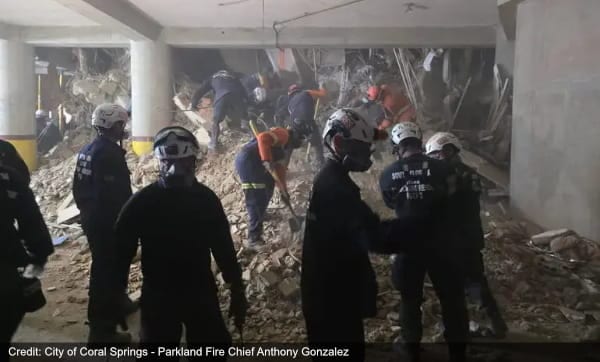
For eight days, Hernán Gil Flores remained trapped beneath what had been a shopping center in Venezuela.
Above him was a landscape transformed by earthquakes. Concrete had collapsed. Buildings had become unstable.
Rescue teams from several countries were working through debris where moving the wrong piece could create another collapse.
Rescuers managed to maintain contact with Flores and provide water and nutrition while teams carefully worked toward him.
Among the responders participating in the effort were personnel from Coral Springs.
Their presence thousands of miles from home might seem surprising.
It shouldn't. Because hidden inside the emergency-response system residents see every day is another system most people rarely have reason to notice.
Local Responders, Much Larger Network
Seven Coral Springs fire and city personnel deployed following the devastating June 24 earthquakes in Venezuela.
Six were members of the Coral Springs-Parkland Fire Department, while another was a retired fire chief who now works for the city.
They joined more than 160 South Florida responders assigned to urban search-and-rescue teams.
The Coral Springs personnel deployed with Florida Task Force 2.
That name probably means little to most residents. What sits behind it is considerably more interesting.
Florida Task Force 2 is part of FEMA's national Urban Search & Rescue system, a network of specialized teams positioned around the country to respond when disasters exceed the capabilities available locally.
The task force is sponsored by the City of Miami Fire Department, but its personnel come from participating agencies across South Florida.
That includes Coral Springs.
So some of the people residents think of as members of a local fire department also occupy another role. They are part of an emergency-response capability designed to travel.
Training for What Ordinary Emergencies Don't Require
Most calls handled by a fire department don't involve crawling through collapsed buildings after major earthquakes.
Urban search and rescue requires specialized capabilities for extraordinary situations.
FEMA task forces are prepared for work that can include searching collapsed structures, technical rescue, emergency medical operations, structural stabilization, reconnaissance and hazardous-material assessment.
Those skills become particularly important after earthquakes, hurricanes, explosions and other disasters capable of damaging buildings on a large scale.
The work can be painstaking.
Coral Springs-Parkland Battalion Chief Anthony Gonzalez described the Venezuela rescue almost like an operation.
“It becomes like a surgical procedure,” Gonzalez said. “You remove piece by piece, deliberately and strategically.”
At one structure, rescuers had to withdraw after the building shifted and was determined to be unsafe.
That is the environment these teams are trained to enter. Not recklessly. Methodically.
Eight Days Beneath the Rubble
The rescue of Flores showed why that specialization matters.
The security guard had been trapped beneath the collapsed Galerías Playa Grande shopping center near Caracas following the earthquakes.
Teams from multiple countries participated in the effort. Coral Springs personnel were part of Florida Task Force 2's work alongside rescuers from countries including Chile, Mexico, Ecuador and Portugal.
Cameras allowed rescuers to monitor Flores. Tubing allowed them to provide water and nutrition. Then came the slow work of creating a safe path through the debris.
Florida Task Force 2 spent more than two days working on the rescue as part of a larger multinational operation that continued for days.
Flores was finally reached on July 2.
“We didn't give up on this person,” Gonzalez said. “We stuck to it, and we got him out.”
One life emerged from an enormous field of destruction. For Gonzalez, who has deployed to other major disasters during more than a decade with Florida Task Force 2, Venezuela stood apart.
He described it as the worst destruction he had ever seen.
Why Coral Springs Is Part of This
There is an important reason disaster-response teams aren't assembled from scratch after catastrophe strikes.
Specialized rescue requires people who already know how to operate together, equipment that is ready to move and training that occurs before anyone knows where the next disaster will happen.
FEMA's Urban Search & Rescue system provides that structure. Twenty-eight task forces are positioned around the United States.
When needed, that allows trained personnel and specialized resources normally distributed across different communities to converge on one disaster.
The system effectively turns local expertise into a national—and sometimes international—resource.
Coral Springs is one piece of that network. The Coral Springs-Parkland Fire Department has documented its participation with Florida Task Force 2, and Gonzalez has been associated with the team since 2011.
His previous deployments have included Hurricane Michael and earthquakes in Puerto Rico.
Most days, however, that expertise isn't operating in a distant disaster zone. It's here.
The Capability Residents Rarely See
That may be the most meaningful Coral Springs connection. Residents typically experience their fire department through ordinary local emergencies.
A medical call. A vehicle crash. A fire. A hurricane response.
Those encounters reveal only part of the expertise that can exist within a modern fire department.
Some responders develop highly specialized capabilities for situations they may encounter rarely during their careers.
That's intentional.
Communities don't begin preparing for catastrophic events after they happen. They maintain people, training, equipment and relationships capable of responding if they do.
Sometimes that capability is needed at home. Sometimes another community needs it more.
When that happens, the larger response system allows expertise developed in one place to move somewhere else.
What Comes Home
There is another side to deployment. Responders return.
Gonzalez has now worked amid earthquake destruction, hurricane damage and collapsed structures in several different places.
Every deployment exposes responders to conditions that can't be completely recreated during training.
They see how structures fail. How rescue operations evolve. How teams from different agencies work together. How decisions are made when conditions remain dangerous.
The Venezuela mission was an extreme example. Thousands were killed after the earthquakes, and entire communities faced enormous destruction.
Against that backdrop, rescuing one person after eight days beneath concrete can seem impossibly small.
For the person who came out alive, it was everything. And for Coral Springs residents, the mission provides a rare glimpse at something much closer to home.
The firefighters and rescue personnel serving a community are not defined only by the emergencies that happen inside its boundaries.
Some are also connected to systems designed around a larger idea: When disaster overwhelms one place, expertise from many other places can move toward it.
For several days this summer, some of that expertise came from Coral Springs. Then it came home.
----------
Editor’s note: This piece was selected and adapted for Coral Springs Insider to provide local context and perspective on an issue relevant to our community. |
0 Comments
Join the conversation
Be the first to comment
Share your thoughts above.