
Why Students With Disabilities Are Getting Work Experience Before They Leave School |
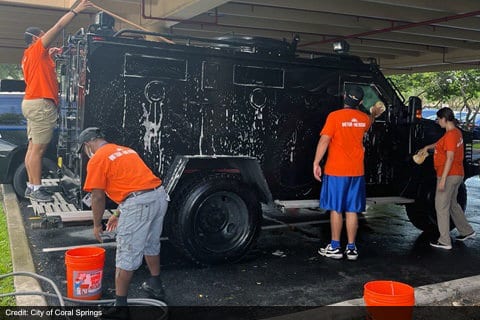
Each summer, a small group of young people comes to work for the City of Coral Springs.
They help with landscaping projects. They distribute internal mail. They wash police and fire vehicles.
There are usually only four or five of them.
What makes the jobs notable isn't primarily what they're doing. It's when they're doing it.
The students have disabilities and participate through Arc Broward's Youth Links program, which helps young people develop employment and independent-living skills while they are still in the transition from school to adult life.
An Arc Broward job coach works alongside them.
That means the workplace becomes something more than a place to earn a paycheck. It becomes a place to practice what comes next.
A First Job With Support Still Nearby
Youth Links works with students and young adults with disabilities before they have fully crossed from school into adult employment.
During the school year, participants work on career development, social skills, life skills, self-determination and advocacy.
On non-school days, they can visit colleges and businesses and participate in volunteer and service-learning experiences. Then summer changes the setting.
Participants can move into paid employment, generally working between 16 and 30 hours per week.
Those who don't participate in paid employment can receive other work-based experiences, including job shadowing, job tours, mock interviews and volunteer work.
This summer, 49 young adults participated in paid internships with employers that included Publix, Walgreens, Broward County Animal Care and the City of Coral Springs.
Coral Springs' involvement isn't new.
The city says it partners with Arc Broward each year, typically hosting four or five students for summer internships. The assignments may look ordinary.
That's part of their value.
Learning the Things a Workplace Assumes You Know
A first job teaches plenty that isn't contained in the job description.
Arrive when you're expected. Understand what a supervisor is asking. Move from one assignment to another. Work alongside people you didn't choose. Ask for help when you need it. Finish something even when it becomes repetitive.
For many teenagers, those lessons arrive informally through a first summer or part-time job.
For students with disabilities, Florida's own transition programs treat those experiences as something worth developing deliberately.
The state's Division of Vocational Rehabilitation offers Pre-Employment Transition Services to students with disabilities beginning while they are still in school.
Those services include job exploration, workplace-readiness training, self-advocacy and work-based learning.
The timing is intentional.
The idea is to begin preparing for employment before the structures of school fall away.
The Gap Waiting on the Other Side
There is a reason that transition receives so much attention.
Young adults with disabilities enter a labor market in which their peers without disabilities are considerably more likely to be working.
In 2025, 42.3% of Americans ages 20 to 24 with disabilities were employed, according to the U.S. Bureau of Labor Statistics. Among people the same age without disabilities, 66.9% were employed.
The unemployment rate tells another part of the story.
For 20- to 24-year-olds with disabilities who were participating in the labor force, it was 15.7%. For those without disabilities, it was 8%.
Those are national figures, not Coral Springs or Broward statistics, and they include people with many different types of disabilities.
They don't tell us what will happen to any particular Youth Links participant. But they help explain why the period between school and employment deserves attention.
Leaving school doesn't automatically create a path into the workforce.
Sometimes that path has to begin earlier.
Why Real Work Is Different
A classroom can teach someone how to write a résumé.
A mock interview can make the first real interview less unfamiliar. Career counseling can help someone identify the kind of work that might fit.
But none of those experiences fully recreates having a place where you're expected to show up and contribute.
That's where paid work adds something different.
At Coral Springs, Youth Links participants aren't simply touring city departments to see what employees do.
They're given assignments.
Landscape beautification, mail distribution and vehicle washing aren't glamorous tasks. They don't need to be.
The point of an early work experience isn't necessarily to identify someone's lifelong career. It can be to make employment itself familiar.
There is a difference between understanding that adults have jobs and beginning to understand what having one feels like.
The Coach Doesn't Remove the Expectations
Youth Links also adds something most first jobs don't provide. Support follows the participant into the workplace.
Coral Springs says students work alongside an Arc Broward job coach as well as a city intern.
That creates an unusual middle ground.
It isn't a classroom simulation of employment. But it isn't yet employment without support, either.
Students can encounter real workplace expectations while someone is still available to help them understand those expectations.
That fits the larger approach Florida uses for students with disabilities: career exploration, work readiness and work-based experience happen before the transition out of school is complete.
The goal isn't to make employment less real. It's to make the first exposure to it less abrupt.
A Paycheck Is Part of the Lesson
There is another distinction worth noticing.
These summer placements are paid. That's important because employment isn't simply a life-skills exercise.
Work has economic meaning. A paycheck introduces another part of adult life: contributing time and effort in exchange for money.
For a young person beginning to think about independence, that relationship matters.
Youth Links also works on self-determination, advocacy and life skills outside the summer employment period. Taken together, those experiences connect employment with something broader than a particular job.
They connect it with participation in adult life.
What We Don't Know Yet
It would be easy to turn a program like this into a success story before the evidence allows it.
We don't have public Youth Links data showing what percentage of participants eventually obtain permanent employment.
We don't know how many remain employed several years after leaving the program.
And the national employment gap doesn't prove that a particular internship will change an individual student's outcome.
Those distinctions matter.
The strongest case for the program doesn't require making that promise.
What we can see is what happens before the outcome is known. Students get to encounter work while support is still available.
They get to discover what they're good at, what they need help with and what employers expect.
And employers get experience working with people whose path into the workforce may look different from the one they are accustomed to seeing.
Before the Structure Changes
Graduation is usually described as an ending. For students with disabilities, it can also represent a change in the systems surrounding them.
School has schedules, teachers, counselors, accommodations and people whose job includes helping students prepare for what comes next.
Adult life works differently.
Programs such as Youth Links operate in the space between those two worlds.
For a few students each summer, that space includes City Hall, landscaping projects, stacks of internal mail and police and fire vehicles waiting to be washed.
None of those assignments can tell us what those students will be doing five or ten years from now.
But that's not really what a first job has to accomplish.
Sometimes its purpose is simply to make the second job — and the expectations surrounding it — less unfamiliar.
For some young adults, the first job isn't only the beginning of employment. It's one of the places where adulthood gets practiced before the support of school is left behind.
The local factual foundation is particularly strong: Coral Springs says it hosts four or five Arc Broward students each year, accompanied by a job coach, with assignments including landscaping, internal mail and washing police and fire vehicles.
Arc Broward says Youth Links participants can work 16–30 hours per week during summer, while students not in paid employment can receive job-shadowing, mock-interview, volunteer and other community-based experiences.
The broader interpretation is also grounded rather than assumed.
Florida Vocational Rehabilitation explicitly describes work-based learning, work readiness, self-advocacy and career exploration while students are still in school as preparation for transition into education, training and employment.
And the employment comparison is current: in 2025, the employment-population ratio among 20–24-year-olds with disabilities was 42.3%, versus 66.9% among those without disabilities; unemployment rates were 15.7% and 8.0%, respectively.
Learn more about the program here.
What did your first job teach you that you couldn't have learned in a classroom?
Share your experience below.
----------
Editor’s note: This piece was selected and adapted for Coral Springs Insider to provide local context and perspective on an issue relevant to our community.
|
0 Comments
Join the conversation
Be the first to comment
Share your thoughts above.