
What Happens When a Hotel Becomes a Long-Term Home |
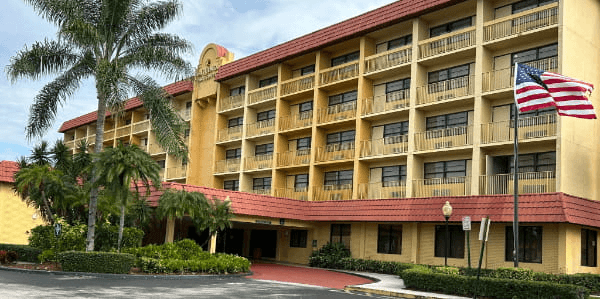
For years, the La Quinta Inn & Suites on University Drive served a familiar purpose.
Travelers checked in for a night or two. Business visitors came and went. Guests used the building temporarily before moving on to somewhere else.
If a proposal now under review moves forward, the same building could soon become something very different.
The Tunnel to Towers Foundation plans to convert the five-story hotel into a Veterans Village containing 121 residential units, along with a gym, workforce development center, dining facilities, pantry, canteen, and other support services designed to help veterans build stability and independence.
The proposal is notable because of who it would serve.
But it is also notable because of what it says about how communities are increasingly approaching complex challenges.
A Different Way of Thinking About Space
For much of the last century, solving a community problem often meant building something new.
Need more housing? Build apartments.
Need more services? Build a facility.
Need more community space? Build a center.
Today, that approach is becoming more difficult.
Land is limited. Construction costs remain high. Projects often take years to complete.
As a result, communities are increasingly looking at existing structures through a different lens.
The question is no longer simply: "What was this building designed to do?"
It is increasingly:
"What else could this building become?" - Across the country, offices are being converted into residential units.
- Former retail spaces are becoming medical facilities. Vacant commercial properties are finding new life through alternative uses.
The proposed Veterans Village fits within that broader pattern.
More Than Housing
One detail in the proposal stands out.
The first floor is not being dedicated primarily to additional residential units.
Instead, plans include a workforce development center, gym, dining space, pantry, screening room, and other shared facilities.
That distinction matters.
The project is not simply focused on where people sleep. It is focused on what happens after housing is secured. Housing conversations often center on unit counts.
How many units?
How many beds?
How much capacity?
Those questions are important.
But long-term stability often depends on more than a roof. It depends on access to resources, support systems, routines, relationships, and opportunities.
The proposal reflects an understanding that shelter and stability are not necessarily the same thing.
What This Reveals
The deeper story may be less about this specific building and more about a changing philosophy.
Communities increasingly face challenges that require faster and more flexible solutions than traditional development models can provide.
Rather than waiting years to create entirely new infrastructure, organizations are increasingly adapting what already exists.
That approach does not solve every problem. Nor does every building lend itself to a new purpose.
But adaptive reuse allows communities to respond in ways that are often faster, less expensive, and more practical than starting from scratch.
The La Quinta was originally designed to provide temporary accommodation. The proposal asks whether the same structure can now support something much more permanent.
Why This Matters Over Time
The Veterans Village proposal may ultimately become one project among many.
Yet it reflects a larger shift that residents are likely to encounter more frequently in the years ahead.
Buildings that once served one purpose may increasingly be asked to serve another. The result is a community landscape that becomes more flexible and responsive to changing needs.
Most people driving past the hotel today see a familiar building.
The more interesting possibility is that communities are beginning to see familiar buildings differently.
Sometimes the biggest change is not the structure itself. It is the way people imagine what that structure can become.
----------
Editor’s note: This piece was selected and adapted for Coral Springs Insider to provide local context and perspective on an issue relevant to our community.
|
0 Comments
Join the conversation
Be the first to comment
Share your thoughts above.