
Why Sandy Ridge Sanctuary Exists in the Middle of Coral Springs |
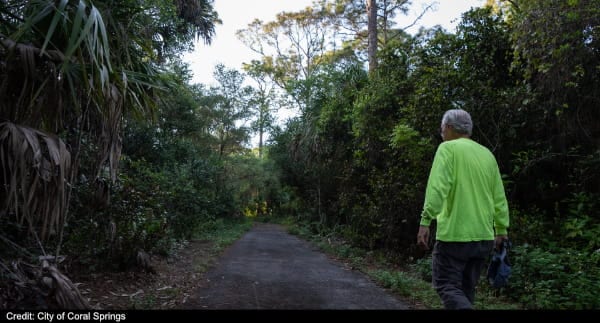
During Coral Springs' rapid growth, residents voted to spend millions preserving environmentally sensitive land. Three decades later, one of those decisions has become a 38-acre part of the city residents can simply walk into.
Walk through Sandy Ridge Sanctuary today and it can feel as though this particular piece of Coral Springs was simply left alone.
Nearly 38 acres sit east of University Drive between Sample and Wiles roads, surrounded by the neighborhoods, roads and businesses of a mature suburban city.
Step inside and you'll discover slash pines, oaks, bald cypress, wetlands and wildlife within a city shaped by decades of residential and commercial development.
But Sandy Ridge wasn't merely overlooked while everything around it grew. Its existence required a decision.
And more than 30 years later, most residents experience the result without ever having to think about the choice that created it.
When Open Land Had Another Possible Future
In the early 1990s, Coral Springs was still growing rapidly. That growth created a question cities often confront only after much of their open land is already gone:
How much should be allowed to develop, and what should deliberately remain?
Sandy Ridge was among the remaining environmentally significant properties.
Broward County had already designated the land a Local Area of Particular Concern in 1989 because of its native vegetation and preservation value.
A later historical account from the landscape architecture firm involved with the sanctuary described the property as containing what was then the largest remaining contiguous pine flatwoods community in Broward County.
But environmental value didn't automatically guarantee preservation. The land also had development potential.
According to local historical accounts, the property that became Sandy Ridge had been slated for 195 zero-lot-line homes.
That would have produced a very different piece of Coral Springs.
Residents Were Asked to Make a Choice
In 1994, Coral Springs voters considered a $7.5 million bond referendum to acquire, preserve and enhance environmentally sensitive lands within the city.
About 63% voted yes.
The money wasn't devoted solely to Sandy Ridge. The larger preservation effort helped protect several natural areas in Coral Springs, with state funding also supporting conservation acquisitions.
Official Florida Communities Trust records put the Sandy Ridge project itself at approximately $3.39 million, including about $1.25 million from the state program.
Those numbers describe a land transaction.
What they don't capture as easily is what voters were actually deciding. They were spending public money on something residents wouldn't necessarily experience immediately.
There would be no new building to point to. No new facility. No new road.
The intended result was largely the opposite: A place where some of the city's remaining natural landscape wouldn't become something else.
Preservation Didn't Mean Doing Nothing
Even after Sandy Ridge was protected from development, creating the sanctuary residents know today required more than putting up a fence.
Historical accounts of the project describe a property affected by illegal dumping, invasive vegetation, uncontrolled vehicle access and other pressures associated with surrounding development.
Restoration work included removing invasive plants such as Brazilian pepper and melaleuca, restoring native habitat and managing the property for public access and wildlife.
That's an important distinction. Preservation can sound passive.
At Sandy Ridge, it wasn't.
Choosing not to develop the property created another responsibility: maintaining and restoring what had been preserved.
A Refuge From Development — Twice
One of the sanctuary's later roles makes that history particularly tangible.
Sandy Ridge became a protected site for gopher tortoises, a threatened species in Florida whose habitat is frequently affected by development.
Tortoises displaced from other locations have been relocated to the sanctuary.
There's an unusual symmetry in that.
Land that was itself preserved from development eventually became habitat for wildlife displaced by development somewhere else.
A decision about one property began serving purposes that residents voting in 1994 may not have been able to foresee.
What 195 Homes Would Have Meant
It's tempting to focus on the number. Local historical accounts say 195 homes were planned for the Sandy Ridge property before its preservation.
But the point isn't that building those homes would necessarily have been wrong.
Coral Springs needed homes. Its population was growing. Much of the city residents know today exists because land was developed during that same period.
That's precisely what makes Sandy Ridge interesting.
Cities aren't created simply by choosing development or preservation. They're created by deciding **where each belongs**.
Most of those choices eventually disappear from view.
A subdivision simply becomes a neighborhood. A shopping center becomes somewhere people run errands. A road becomes the route someone takes to work. And protected land eventually becomes something people assume was always going to be there.
When a Decision Becomes a Place
Former Coral Springs Mayor Roy Gold still leads monthly walks through Sandy Ridge Sanctuary.
That creates an unusual connection between the city's past decision and its present-day result.
People arriving for one of those walks aren't attending a bond referendum. They're not reviewing acquisition documents or debating development plans.
They're walking trails. They're looking for wildlife. They're standing beneath trees.
That's what happens to many consequential local decisions over enough time.
The politics, meetings, financing and arguments recede. The physical result remains.
The Coral Springs That Wasn't Built
There's no way to stand at Sandy Ridge today and see the alternative version of the property.
There are no outlines showing where streets might have gone. No markers indicating where houses might have stood. Instead, there's a sanctuary.
That's why the history matters. Every developed city contains places that could have become something else.
Usually residents see only the choice that won. Sandy Ridge offers a rare opportunity to recognize the other side of that equation.
Coral Springs wasn't shaped solely by the neighborhoods, roads, businesses and public facilities people decided to build. It was also shaped by places residents decided were worth keeping from becoming those things.
Sandy Ridge looks like a piece of Coral Springs that development simply passed by. It isn't.
It's what one of the city's decisions looks like more than 30 years later.
What other places in Coral Springs do you think the city would feel fundamentally different without today?
Tell us below.
----------
Editor’s note: This piece was selected and adapted for Coral Springs Insider to provide local context and perspective on an issue relevant to our community. |
0 Comments
Join the conversation
Be the first to comment
Share your thoughts above.